

There’s a new study highlighting AI’s limitations when it comes to celiac disease, and educators in the celiac disease community are urging the public to be cautious about the information they read online. In this post, you’ll learn why you shouldn’t rely solely on AI for information about celiac disease.
You will learn the following about AI and Celiac Disease:
- Why is AI not the best source of information about celiac disease?
- What are better places to search for answers and maintain long-term goals?
- Which AI platform has the most accurate and readable information?
What’s happening with AI and celiac disease
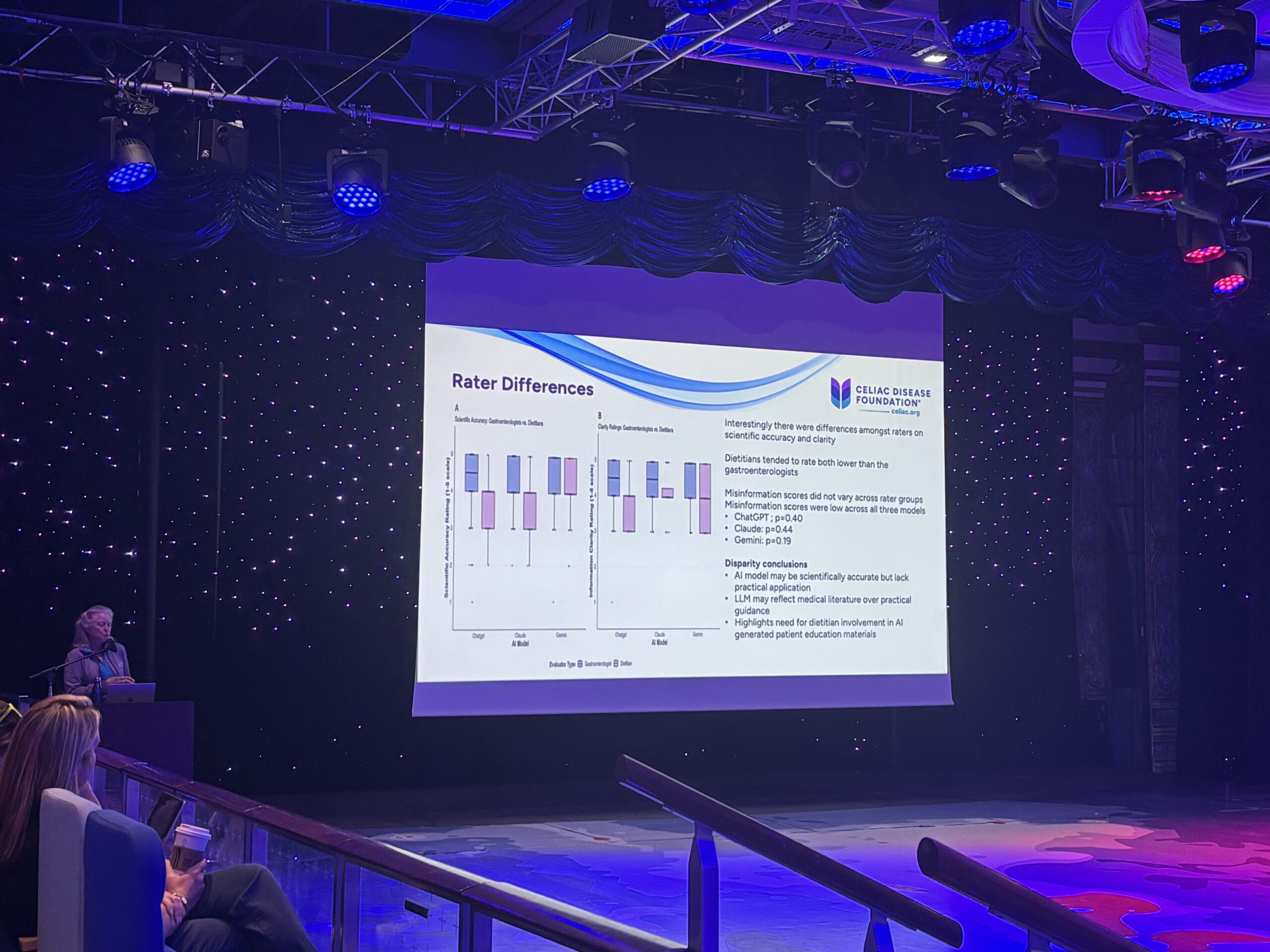
Recently, I attended a Celiac Disease Foundation conference on the Celiac Cruise with Royal Caribbean. We learned about a new study showing AI is not completely up to speed with information about celiac disease. The study evaluated 3 different AI platforms, ChatGPT, Claude, and Gemini, using four gastroenterologists and two dietitians. They asked 20 questions centered around general understanding, symptoms/diagnosis, diet/nutrition, and lifestyle management. The answers were scored on a scale of 1-5 for misinformation and readability. (See Table 1)1

Questions asked to AI during a 2025 study published in Nutrients about Celiac Disease
“So many of our patients use AI for quick answers for many of their health questions. While the three models are quick and accessible tools, it is worrisome that almost 25% of the information contained errors or out dated information.”
Anne Lee, EdE, RDN, LD, study author, educator, and member of the Celiac Disease Foundation Dietitian Advisory Council (CDF-DAC), presenter at the Celiac Cruise
Why this matters
Overall, AI is convenient, but not the best source of information for celiac disease. It may actually contain incorrect and unreadable information. While Gemini is rated the highest for answers about celiac disease, ChatGPT ranks the lowest. Why? Much of the information is not written at a level accessible to the general public. Basically, someone would need a college degree and/or a doctorate to understand the terminology. We are all smart here, but what about the average person who is new to celiac disease and just wants answers to their questions? Then, AI makes it harder for them to understand the basics of the disease and establish long-term goals.
Besides the readability issues, AI lacked an understanding of how to maintain the disease and control it. We know that the only cure for celiac disease is eating a gluten-free diet. However, there’s more to that, because someone with celiac should also follow a GI doctor and see them at least once a year.
AI suggests food diaries, but again, there’s more depth to that. If you have celiac disease, you should also see a trusted nutritionist and speak to them about how food makes you feel.
Moreover, there’s a disconnect between when kids transition from pediatricians to regular GI doctors, which is not referenced through AI. Sometimes they stop seeing their GI doctor, which is essential to control the disease.

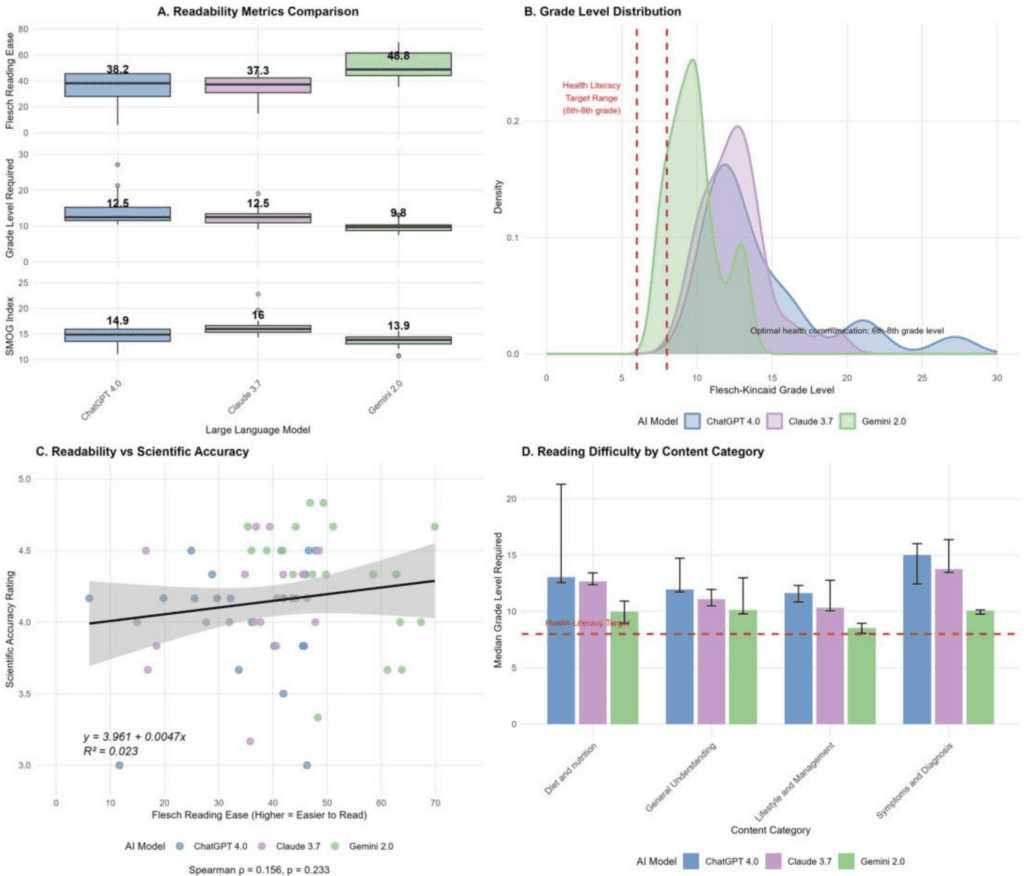
Readability Metrics, Comparison, Bertin et al., Nutrients (2025), Figure 3.
What this Means for You
Build Your GF Community! Long-term maintenance for celiac disease should not be solely focused on trusting AI. If I learned anything from my Celiac Cruise, it was that you should build community with people who share the disease. The best part of the Celiac Cruise was watching my son, Gabriel Francis(GF) Dalesio, laugh and connect with other kids his age who have celiac disease. Where else can you collect moments like this?
You can’t find a human connection with AI or share jokes. AI is not going to make diabetes ice cream, which my son made with his friends. They gathered sugar packets, stirred them into the ice cream, and said it’s 200 calories per bite. Then they dared each other to try it. My son dipped a French fry into the bowl and had a taste. Gross, the kids loved it, though. On another night, they all dissected a crawfish and laughed hysterically.
What You Should Do Now with AI and Celiac Disease
Follow up with your GI doctor and Nutritionist. If you have a young adult transitioning from a pediatrician to a regular adult GI doctor, help them make that connection and stay consistent with their appointments.
Keep a food diary, but share it with a trusting dietician who will listen to you; if they don’t, find another one. Can’t afford healthcare or sustain celiac disease? Thanks to a fabulous donor, the Celiac Disease Foundation provides a FREE Education series for those newly diagnosed with celiac disease who experience food insecurity. Besides the education, they can provide ways and means to maintain a gluten-free lifestyle, even for those who cannot afford gluten-free food. To learn more about this free education series, click here. Beyond that, the Celiac Disease Foundation offers a Virtual Education Series.
Key Takeaways About AI and Celiac Disease
The bottom line is that for accurate information about celiac disease, refer to reputable websites and organizations, like the Celiac Disease Foundation, and consult with trusted experts. AI can definitely provide incorrect information, and will not help you build meaningful connections in your community. For the best AI information about celiac disease, use Gemini.
Also Read: Don’t Eat the Plates: Why people with celiac disease shouldn’t eat edible plates.
- Luisa Bertin et al., “Efficacy of Large Language Models in Providing Evidence-Based Patient Education for Celiac Disease: A Comparative Analysis,” Nutrients 17, no. 24 (2025): 3828, https://doi.org/10.3390/nu17243828. ↩︎






Comments are closed.